We provide a one-stop service integrating design, production, delivery, installation, staff training and after-sales service for soap making project.
Language
Extruder
Extruders originated in 18th-century England and are used in the rubber and plastics industry, food machinery, brick manufacturing,
ceramics, and other industries.
Screw extruders rely on the pressure and shear force generated by the rotation of the screw to fully plasticize and uniformly mix the
material, which is then shaped through a die. Soap extruders can be broadly classified into twin-screw extruders and single-screw
extruders.
It mainly consists of six parts: the transmission system, feeding device, barrel, screw, die head, and die.
>>>It mainly consists of six parts: the transmission system, feeding device, barrel, screw, die head, and die.
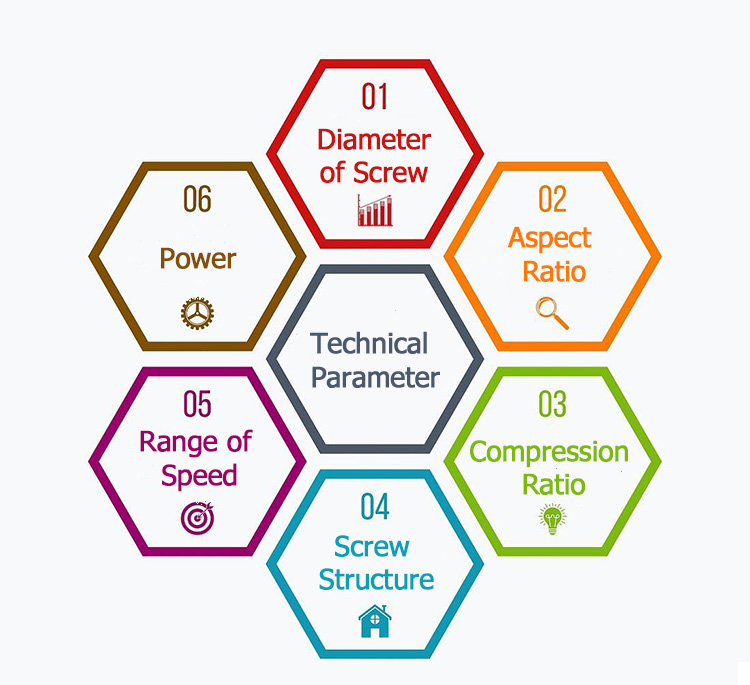
>>>Length-to-diameter ratio: The ratio of the working length of the screw to its outer diameter.
>>>Compression ratio: The ratio of the volume of the first screw groove to the volume of the last screw groove.
>>>Cold feeding: This process eliminates the need for a hot mixing step; the rubber strips or viscous rubber compound
are fed directly into the extruder at room temperature.
>>>The high compression ratio is necessary to enhance the shearing and mixing action of the screw, ensuring that the
material achieves uniform temperature and plasticity.